FWD FORGINGS Delivers Premium 20CrMo Rotary Drilling Rig Joints, Earns Top Customer Acclaim
July 30, 2026
FWD FORGINGShas just deFWD Forgings Delivers High-Quality Rotary Drilling Rig Joints for Construction Applications
FWD Forgings has successfully delivered a batch of forged rotary drilling rig joints to its customer, receiving positive feedback for product quality and manufacturing reliability.
These 20CrMo forged joints are critical connection components used for installing spiral drill bits on rotary drilling rigs and excavators. Acting as the mechanical and hydraulic interface between the drill bit and the equipment power head, they play an essential role in construction machinery applications, including excavation, piling, tree pit drilling, utility pole installation, and photovoltaic (PV) mounting pile projects.
As an experienced custom metal forging manufacturer, FWD Forgings provides engineered forged components manufactured according to customer specifications, material requirements, and application conditions.
Manufacturing Process of Rotary Drilling Rig Joints
To ensure structural strength, dimensional accuracy, and long-term reliability, these 20CrMo forged joints undergo a controlled manufacturing process covering material inspection, forging, heat treatment, and final quality verification.
Raw Material Selection and Verification
The production starts with high-quality continuous casting billets sourced from reliable steel suppliers. Each batch undergoes chemical composition analysis through spectrometric testing, with results verified against the original mill test certificates.
After approval, materials are assigned internal tracking numbers to ensure complete traceability throughout the manufacturing process.
Precision Cutting and Controlled Heating
Qualified raw materials are cut according to production requirements and clearly identified with contract information and material specifications.
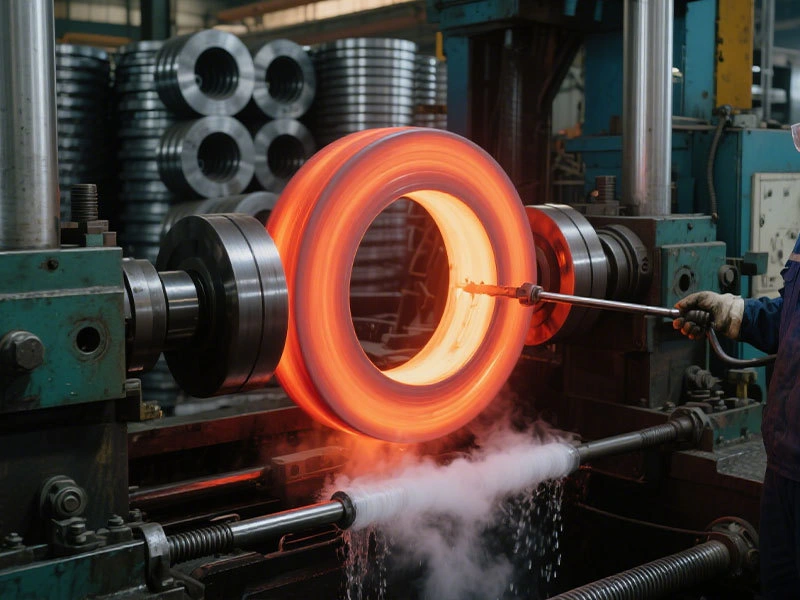
Before forging, billets are uniformly heated under strict temperature control. Maintaining consistent heating conditions helps prevent uneven temperature distribution and ensures stable forging quality.
Precision Forging Process
During forging, the required forging ratio is strictly controlled to improve internal structure and mechanical properties.
The forging process includes:
- Controlled upsetting and compression
- Scale removal and surface inspection
- Uniform deformation control
- Defect prevention during forming
Finished forgings are inspected to ensure surfaces remain free from defects including cracks, laps, seams, and other imperfections.
Heat Treatment and Mechanical Performance Control
After forging, components undergo appropriate heat treatment processes, including normalizing or annealing according to material requirements.
Quenching and tempering (QT) are applied when required to achieve the targeted strength, toughness, and wear resistance for demanding construction applications.
Non-Destructive Testing and Final Inspection
Quality verification includes non-destructive testing (NDT) at different production stages.
Inspection records include:
- Forging quality inspection
- NDT reports
- Dimensional verification
- Material traceability documentation
Any non-conforming components are identified and handled according to quality procedures.
Final Processing and Delivery
After rough machining, final inspection, and quality approval, finished forged joints are securely stored and delivered according to customer requirements.
The completed components are ready for installation in rotary drilling equipment and construction projects.
Reliable Forging Solutions for Construction Machinery
Forged components used in construction equipment must withstand heavy loads, repeated impact, and demanding working environments. Through controlled forging processes and strict quality management, FWD Forgings delivers durable components designed for long-term industrial performance.
From drilling rig joints and heavy machinery parts to customized forged components, FWD Forgings supports global customers with reliable manufacturing capabilities and application-focused forging solutions.