
Why Choose Forging Over Casting for High-Stress Industrial Components?
November 6, 2026
Forging delivers superior structural integrity, directional grain flow, and impact resistance because mechanical pressure deforms metal in a solid state, whereas casting pours molten metal into molds which introduces risks of internal porosity and shrinkage voids. Engineers select forging for heavy-duty applications where component failure carries catastrophic safety and financial consequences. The mechanical deformation refines the internal micro-structure, closing microscopic gas pockets and eliminating structural flaws. Industrial buyers evaluating production methods must weigh initial tooling investments against long-term operational reliability in severe service environments. This analysis compares both manufacturing techniques across technical performance metrics, structural characteristics, and economic factors.
Fundamental Manufacturing Process Differences
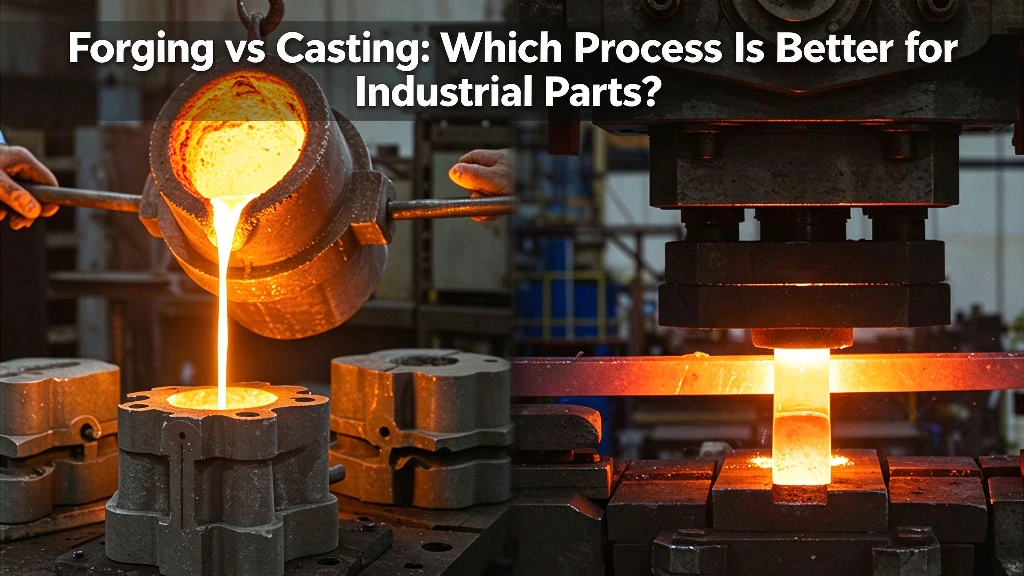
Manufacturing methods dictate the physical state of the metal during shaping operations. Casting involves melting raw metal ingots at high temperatures and pouring the liquid into a pre-formed cavity or sand mold. As the liquid metal cools, it solidifies into the desired geometry, but uncontrolled cooling rates can create internal shrinkage cavities and gas bubbles. Forging utilizes compressive forces applied through hydraulic presses, mechanical hammers, or closed dies to shape preheated solid metal billets. This solid-state plastic deformation reorganizes the internal crystalline matrix without melting the material. The choice between liquid solidification and solid-state deformation directly influences the final mechanical properties of heavy machinery parts.
Structural Integrity and Internal Grain Flow
Internal grain structure represents a primary differentiator between forged and cast components. Liquid metal poured into a casting mold cools uniformly from the mold walls inward, resulting in random, non-directional crystal growth. This random grain orientation reduces resistance to high directional stress and dynamic fatigue loads. Forging forces the metal grains to flow continuously along the contour of the component geometry. This unbroken grain lines significantly increase resistance to impact, shear stress, and tensile loads. Heavy-duty power transmission components, such as shaft forgings, rely heavily on this continuous grain structure to transmit high torque without premature fatigue cracking.
Mechanical Strength, Ductility, and Fatigue Resistance
Mechanical performance metrics determine how well a component withstands operational loads in the field. Cast metals often exhibit lower tensile strength and reduced ductility due to inherent microporosity and microshrinkage defects. Forged components achieve higher yield strength, superior elongation percentages, and exceptional impact toughness through intense compressive refinement. The table below compares typical mechanical and structural attributes of forged steel versus cast steel components.
| Comparison Parameter | Forged Steel Components | Cast Steel Components |
| Internal Porosity | Minimal to non-existent due to mechanical compaction | Prone to shrinkage voids and gas pockets |
| Grain Structure | Continuous, directional grain flow following part contours | Random, dendritic crystal orientation |
| Tensile Strength | Higher baseline tensile and yield strength | Moderate tensile strength requiring thicker walls |
| Impact Resistance | Excellent resistance to shock loads and fatigue | Lower impact toughness under dynamic stress |
| Reliability in Service | Predictable mechanical behavior under severe loads | Higher variance requiring rigorous non-destructive testing |
Table 1: Structural and mechanical property comparison between steel forgings and steel castings.
Cost, Production Volume, and Economic Considerations
Economic evaluations require balancing upfront tooling expenditures against long-term maintenance and replacement expenses. Casting often features lower initial tooling costs, making it attractive for low-volume production of intricate geometries with internal hollow sections. However, casting requires heavier wall thicknesses to compensate for lower material strength, increasing raw material usage and weight. Forging requires higher initial tooling investments for heavy dies and presses, making it more cost-effective for medium to high-volume runs or critical high-stress parts. Industrial machinery builders utilize precision gear forgings to achieve optimal strength-to-weight ratios that reduce overall equipment operating costs over extended service lifecycles.
Ready to evaluate the right manufacturing method for your components? Contact our engineering team today to review your drawings and technical specifications.
Material Versatility and Complex Geometry Handling
Material selection options vary significantly between casting and forging operations. Casting accommodates a vast array of ferrous and non-ferrous alloys because molten metal flows easily into complex mold designs, including intricate internal passages and undercuts. Forging requires materials that exhibit good hot-working plasticity without cracking under extreme pressure. Common forgeable materials include carbon steels, alloy steels, stainless steels, and specialized titanium or aluminum grades. While casting handles extremely complex internal geometries more easily, forging excels at producing robust structural shapes that require maximum density and strength. Engineers frequently design special non-standard forgings when standard commercial sizes or cast alternatives fail to meet rigorous safety factors.
Industry Applications Where Forging Outperforms Casting
Severe operating conditions in heavy industries demand materials that resist cyclic fatigue, high pressure, and abrasive wear. Mining equipment, oil and gas drilling rigs, marine propulsion systems, and heavy-duty automotive assemblies rely almost exclusively on forged components for critical load-bearing parts. For instance, crankshafts, connecting rods, hydraulic cylinders, and high-pressure valves experience continuous stress reversals that would rapidly cause fatigue failure in cast equivalents. The absence of internal voids ensures that forged parts maintain pressure boundary integrity in hydraulic and petrochemical applications. Equipment manufacturers specify forged components to eliminate unexpected field failures and extend maintenance intervals in demanding operational environments.
Frequently Asked Questions
Which manufacturing process is more cost-effective for low-volume prototype production?
Casting generally offers lower initial tooling costs for low-volume prototypes, whereas forging requires higher upfront die expenses that become economical during larger production runs.
Can forged components achieve complex internal cavities like castings?
Forging is primarily suited for external shaping and solid-state deformation; complex internal cavities usually require subsequent machining operations rather than direct forming.
How do porosity issues differ between casting and forging processes?
Casting can trap gas and cause shrinkage voids during solidification, while the high compressive pressure of forging welds internal pores shut and homogenizes the metal density.
Why is grain flow orientation critical for high-stress mechanical parts?
Directional grain flow aligns the metallic crystal structure with expected load vectors, preventing crack initiation and increasing resistance to fatigue failure.
FWD Forgings operates as a dedicated industrial forging manufacturer located in the Zhangqiu Industrial Zone of Jinan, historically recognized as the hometown of blacksmiths. Leveraging this mature industrial cluster, the company supplies high-integrity forged components worldwide. As a vertically integrated manufacturer, complete in-house control is maintained over the entire production cycle, spanning engineering research and development, hot forging, controlled heat treatment, precision CNC machining, and comprehensive metallurgical testing.
Official manufacturing qualifications for special equipment and ISO 9001 quality management certifications back all production operations. Raw materials processed include carbon steel, alloy steel, and stainless steel grades, serving equipment manufacturers, EPC contractors, and industrial distributors across more than 30 countries and regions globally.
References
- ASM International. Forging versus Casting. ASM Handbook, Volume 14A: Metalworking: Bulk Forming. Available online via ASM International.
- Kalpakjian, S., & Schmid, S. R. Manufacturing Engineering and Technology. Pearson Education. Available online via Pearson.
- ISO. ISO 9001 Quality Management Systems – Requirements. Available online via ISO Organization.