
What Is Driving the Impression Die Forging Market, and How Should Buyers Choose a Forging Supplier?
September 30, 2026
The impression die forging market is driven by demand for strong, repeatable metal components in automotive, construction, energy, agriculture, transportation, and industrial equipment. The process forms heated metal between shaped dies under compressive force. This allows manufacturers to produce complex steel components with controlled grain flow and consistent dimensions. For buyers, the key decision is not simply choosing a custom forging supplier. It is selecting the right forging process, material, tooling strategy, inspection plan, and production capacity for the application. A small automotive linkage, for example, may require a different die design and production route from a heavy-duty industrial shaft. Understanding these differences helps procurement teams evaluate forged products on more than unit price.
The term impression die forging generally refers to a process in which the workpiece enters a die cavity that contains the required component geometry. The dies guide material flow during forming. Depending on the component, production may include several stages such as billet preparation, heating, preforming, blocker forging, finish forging, trimming, heat treatment, machining, and inspection. ASM International identifies open-die and closed-die forging as major forging classifications and discusses process variables such as die design, material flow, friction, temperature, and forging load.
For industrial buyers, these process variables have direct commercial consequences. They affect tooling investment, production volume, dimensional control, material utilization, machining allowance, and final component performance. The right approach therefore starts with the application rather than the machine alone.
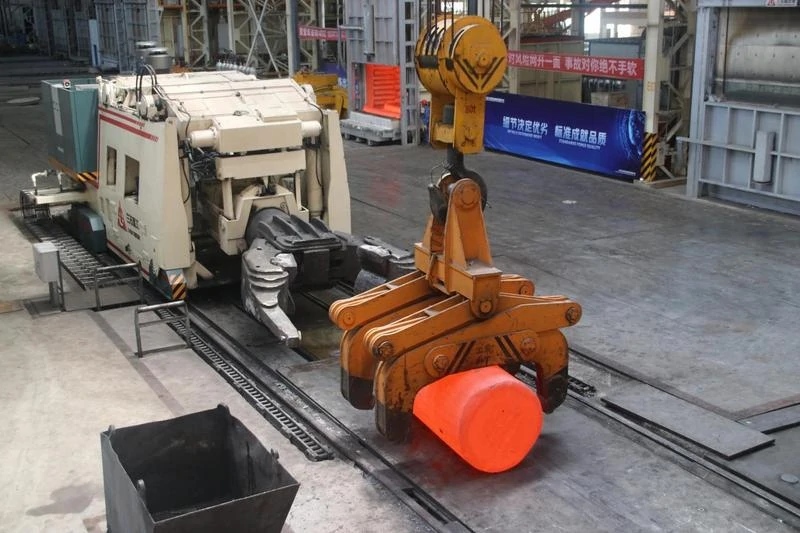
How Does Impression Die Forging Work?
From billet preparation to finished forging
An impression die forging cycle begins with suitable stock material. Steel bar, billet, or another suitable feedstock must meet the required chemical and dimensional specifications. The material then enters a controlled heating process before forming.
Heating gives the workpiece sufficient plasticity for deformation. Temperature control remains important because excessive heating can affect surface quality and material properties. Insufficient heating can increase forming loads and create incomplete die filling.
Once the billet reaches the required temperature, the forging equipment applies compressive force. Depending on the component and production route, the operation may use a hammer, mechanical press, screw press, or hydraulic press.
The die cavity determines the final geometry. Complex parts may require several forming stages to distribute the material correctly. A blocker or preform can reduce the load required during final forging and improve filling of difficult sections.
Why preforming matters
Preforming becomes particularly important when a component contains thick and thin sections. A single forming operation may force too much material into one region while leaving another region underfilled.
A staged process gives engineers greater control over metal movement. ASM International notes that proper preform and blocker design can play an important role in achieving adequate material distribution in closed-die forging.
After finish forging, excess material may remain around the parting line. This material forms flash and normally requires trimming. The flash design also influences die filling and the final geometry.
The forged component may then undergo heat treatment, shot blasting, machining, dimensional inspection, hardness testing, or non-destructive testing.
A practical production example
Consider a forged steering component for an automotive application. The raw billet must first meet the required steel grade. The billet is heated and transferred into a preforming die. The preform then enters the finishing die.
After forging, the flash is removed. The component may receive heat treatment before machining. Critical dimensions can then receive CNC finishing.
This sequence demonstrates why forged steel parts cannot be evaluated only by the final shape. Material grade, forming temperature, die design, heat treatment, machining, and inspection all influence the finished component.
What Is Driving Demand for the Impression Die Forging Market?
The market serves several industrial sectors, but demand varies according to component size, production volume, performance requirements, and cost structure.
Automotive manufacturing remains an important application area. Forged products include shafts, gears, connecting components, suspension parts, steering components, and transmission parts. The U.S. International Trade Commission has identified motor vehicles, construction, agriculture, manufacturing, shipbuilding, rail, aerospace, and power generation among major markets for forged products.
Construction and agricultural machinery create another demand segment. These industries require components that can withstand repeated mechanical loads, impact, vibration, and changing operating conditions.
Energy and heavy industrial equipment require larger and more specialized components. Shafts, flanges, hubs, and other heavy duty forged components can require substantial forming forces and carefully controlled heat treatment.
Transportation equipment also creates demand for forgings. Rail and marine applications may require large components with strict mechanical property requirements.
Automotive applications
Automotive components often require repeatable production at relatively high volumes. This makes impression die forging attractive for suitable geometries.
For example, a manufacturer producing thousands of steering arms may justify dedicated tooling because the tooling cost spreads across a large production quantity. The resulting process can also reduce machining requirements compared with producing the same geometry from a solid block.
Heavy industrial applications
Heavy industrial components may involve lower annual quantities. However, the component value and mechanical requirements can justify customized tooling and controlled forging routes.
A large shaft or structural component may require several forming stages. Material selection, forging ratio, grain flow, heat treatment, and ultrasonic inspection can become important procurement criteria.
Aerospace and power equipment
High-value forgings often require strict material traceability and inspection. Aerospace and power-generation applications can impose detailed requirements for chemistry, mechanical properties, dimensional accuracy, and non-destructive testing.
These applications illustrate an important point. The impression die forging market does not operate as one uniform segment. Different industries place different priorities on production volume, tooling cost, material performance, tolerance, certification, and inspection.
Which Factors Should Buyers Consider When Selecting a Forging Process?
A procurement team should evaluate more than the quoted price per kilogram or per part. The production route determines both cost and technical performance.
The first consideration is component geometry. Parts with repeated shapes and defined production volumes often suit impression die forging. Large, simple, or highly flexible geometries may require another forging route.
The second factor is annual demand. Tooling represents a significant part of the initial investment. A high-volume program can distribute tooling costs across many components. A low-volume project may require a different cost structure.
Material also matters. Carbon steel, alloy steel, stainless steel, aluminum, and other alloys have different forming behavior and temperature requirements. A custom metal forgings program should therefore define the material specification before finalizing the process.
The required mechanical properties also influence the route. Tensile strength, yield strength, hardness, toughness, fatigue performance, and impact resistance may all affect the heat treatment specification.
Dimensional requirements provide another decision point. Forging can produce near-net shapes, but many industrial components still require machining after forging. Buyers should evaluate the total manufacturing route rather than comparing forging prices alone.
Key procurement factors
| Procurement factor | Why it matters | Typical buyer consideration |
|---|---|---|
| Material grade | Controls forming and final properties | Chemistry and material certification |
| Part geometry | Determines die and preform design | Complexity, sections, radii |
| Annual volume | Affects tooling economics | Forecast and batch size |
| Forging temperature | Influences deformation behavior | Controlled heating range |
| Die design | Controls material flow | Preform and finish cavity |
| Heat treatment | Determines mechanical properties | Hardness and strength targets |
| Machining | Achieves final dimensions | Allowance and tolerance |
| Inspection | Confirms quality | Dimensional and NDT requirements |
| Traceability | Supports quality control | Heat and batch records |
| Packaging | Protects finished parts | Export and handling requirements |
For buyers comparing forged metal products from different suppliers, these factors provide a more useful framework than price alone.
How Do Closed-Die and Open-Die Forging Serve Different Markets?
Impression die forging is closely associated with closed-die forging because the dies contain shaped cavities. However, buyers should understand how closed-die and open-die processes differ before selecting a production route.
Closed die forging uses shaped dies to constrain and direct the workpiece. This approach suits many repeatable components with defined geometries.
Open-die forging uses dies that do not completely enclose the workpiece. The operator or automated system controls deformation through repeated passes. This process provides greater flexibility for large and relatively simple components.
The distinction affects tooling investment, achievable geometry, production volume, and dimensional control.
Closed-die forging
Closed-die processes can support complex shapes and repeat production. They can also reduce machining requirements when the die design produces a suitable near-net geometry.
The main commercial consideration is tooling. A dedicated die set requires engineering, manufacturing, maintenance, and replacement planning.
Open-die forging
Open die forging provides greater flexibility for large components and lower-volume programs. It can produce shafts, blocks, rings, and other large forged forms.
The process normally requires more machining to reach complex final geometries. However, it can make sense when component size or production volume does not justify dedicated impression dies.
Choosing between the two
A buyer should consider five basic questions:
- What is the finished component geometry?
- What is the expected annual production volume?
- What material and mechanical properties are required?
- How much machining can the final component tolerate?
- What tooling investment can the project support?
There is no universal forging route for every steel component. The correct process depends on the engineering and commercial requirements of the project.
What Types of Forged Products Are Commonly Used in Industry?
Industrial buyers source a wide range of forged steel parts. The final shape often reflects the load path and installation requirements of the application.
Shafts and rotating components
Shafts transmit torque and mechanical loads. Their design may include steps, shoulders, splines, flanges, keyways, or other features.
For demanding applications, forging can provide a suitable starting structure for subsequent machining. Buyers should specify the required straightness, mechanical properties, surface condition, and machining allowance.
Flanges and connection components
Forged flanges serve piping, pressure, energy, and industrial equipment applications. Material grade and pressure requirements influence the manufacturing specification.
Forged pipe flanges may require dimensional control across bolt holes, sealing surfaces, bore dimensions, and outside diameter. Heat treatment and material certification may also form part of the purchasing specification.
Gears and transmission components
Gears experience repeated contact and torque. Forging can provide the basic geometry before machining and heat treatment create the final tooth profile and surface properties.
Gear applications require careful control of material, heat treatment, dimensional accuracy, and machining allowance.
Heavy-duty industrial components
Heavy duty forged components can include hubs, couplings, connecting elements, structural parts, and large machine components.
These products often require a different production strategy from high-volume automotive parts. Buyers may prioritize forging capacity, material traceability, ultrasonic testing, heat treatment capability, and machining resources.
How Should Buyers Evaluate a Custom Forging Supplier?
Choosing a custom forging supplier requires technical and commercial evaluation. A supplier may offer a low initial quotation but still create higher total costs through tooling changes, inconsistent dimensions, additional machining, or weak quality documentation.
The first step is to review the supplier’s engineering capability. Can the supplier evaluate the drawing, identify difficult sections, and recommend a practical forging route?
Tooling capability also matters. The supplier should understand die materials, cavity design, preforming, flash control, and die maintenance.
Production capacity should match the project. A supplier with suitable equipment must also have enough capacity for the required annual volume.
Quality control deserves equal attention. Depending on the application, inspection may include dimensional measurement, hardness testing, tensile testing, chemical analysis, magnetic particle inspection, ultrasonic testing, or other methods.
Supplier evaluation checklist
A buyer can request the following information during qualification:
- Forging process and equipment range
- Maximum component size and weight
- Material grades supported
- Tooling design and manufacturing capability
- Heat treatment capability
- Machining capability
- Inspection equipment
- Non-destructive testing options
- Material traceability system
- Sample approval procedure
- Production capacity
- Quality documentation
- Packaging and export experience
This information helps buyers compare suppliers on measurable production capabilities.
Why engineering communication matters
A forging project often starts with a drawing rather than a finished production specification. Engineering teams need to discuss draft angles, fillets, machining allowances, parting lines, tolerances, and material flow.
Early engineering communication can prevent costly die modifications later. Process simulation can also support die and preform development. ASM references finite-element modeling as a tool for studying metal flow, strain rate, loading profiles, and microstructural behavior in forging processes.
What Does the Future of the Impression Die Forging Market Look Like?
The impression die forging market will continue to depend on industrial demand, material development, manufacturing efficiency, and component requirements. However, market development does not simply mean higher production volumes.
Manufacturers increasingly need better control of material utilization and process repeatability. These priorities encourage closer integration between forging design, process simulation, tooling, heat treatment, machining, and inspection.
Digital process engineering can support this development. Engineers can use simulation to evaluate metal flow before committing to production tooling. This approach can reduce trial iterations and help identify potential filling or load issues earlier.
Automation also has an increasing role in material handling, heating, forging transfer, trimming, inspection, and production monitoring. The exact automation level depends on production volume and component requirements.
Sustainability is another consideration. Material utilization directly affects the amount of raw material required for a forged component. Better preform design and machining allowances can reduce unnecessary material removal.
For procurement teams, this means supplier selection should increasingly consider the complete production chain. A capable supplier needs more than forging presses. Engineering, tooling, heating, heat treatment, inspection, machining, and quality control all influence project results.
Market example
Consider two customers purchasing steel forging parts.
Customer A needs 500 complex components annually. The parts have tight machining requirements and several critical dimensions. A dedicated impression die process may provide a practical production route.
Customer B needs 20 large components annually. The geometry is relatively simple, but each component weighs several hundred kilograms. Open-die forging may offer greater flexibility.
Both customers need forged products, but their production economics differ significantly. This example shows why market demand cannot be evaluated only by total forging volume. Component geometry, production quantity, material, and end-use requirements all shape the appropriate manufacturing strategy.
FAQ About the Impression Die Forging Market
What is impression die forging?
Impression die forging forms heated metal inside shaped dies. The cavity controls material flow and creates the basic component geometry. Complex parts may use several preforming and finishing stages.
What industries use impression die forging?
Common applications include automotive, construction, agriculture, industrial machinery, transportation, energy, aerospace, and power-generation equipment. Industry demand varies by component type and performance requirements.
Is impression die forging suitable for steel parts?
Yes. Carbon and alloy steels are widely used for forged components. The suitable material grade depends on mechanical properties, service conditions, forming requirements, and heat treatment.
What is the difference between open-die and impression die forging?
Impression die forging uses shaped cavities to control the final geometry. Open-die forging uses simpler dies and provides greater flexibility for large components.
Are forged steel parts ready for final installation?
Not always. Many forged components require trimming, heat treatment, machining, surface treatment, or inspection before final use.
How does production volume affect tooling decisions?
Higher production volumes can spread die costs across more parts. Lower-volume projects may require a different process or tooling strategy. The best route depends on geometry and total production economics.
What should a buyer provide to a forging supplier?
A useful RFQ should include drawings, material grade, annual quantity, dimensional tolerances, mechanical properties, heat treatment requirements, inspection standards, surface requirements, and delivery expectations.
Can a supplier manufacture custom forged parts from drawings?
Many forging manufacturers can develop a process from customer drawings. The engineering team may recommend changes to draft, radii, parting lines, or machining allowances before tooling begins.
Conclusion
The impression die forging market covers a broad range of industrial applications, from automotive components to heavy machinery and energy equipment. Its value comes from controlled metal deformation, repeatable geometry, and the ability to produce components suited to demanding mechanical applications. For buyers, successful sourcing depends on matching the forging process with material, geometry, production volume, tooling requirements, heat treatment, machining, and inspection. A qualified custom forging supplier should therefore contribute engineering input rather than simply quote a part price. When procurement teams evaluate the complete manufacturing route, they can make clearer decisions about forged steel parts, custom forged parts, and other forged metal products.
FWD Forgings focuses on forged components for industrial customers requiring custom metal forgings and steel forging parts. Its production approach can support different component geometries, material requirements, and project volumes. For buyers sourcing heavy duty forged components, the key is to define the technical specification early and align the forging route with the finished application. FWD Forgings works with customers on forging process selection, tooling, production, and quality requirements.
References
- ASM International, ASM Handbook, Volume 14A: Metalworking: Bulk Forming. The handbook covers forging equipment, open-die forging, closed-die forging, impression die forging, process design, dies, materials, and forging defects.
- ASM International, “Closed-Die Steel Forgings.” The reference discusses material selection, quality assurance, dimensional tolerances, and mechanical properties of steel forgings.
- U.S. International Trade Commission, “Overview of the U.S. Forging Industry.” The report reviews major forging applications and industry market segments.